
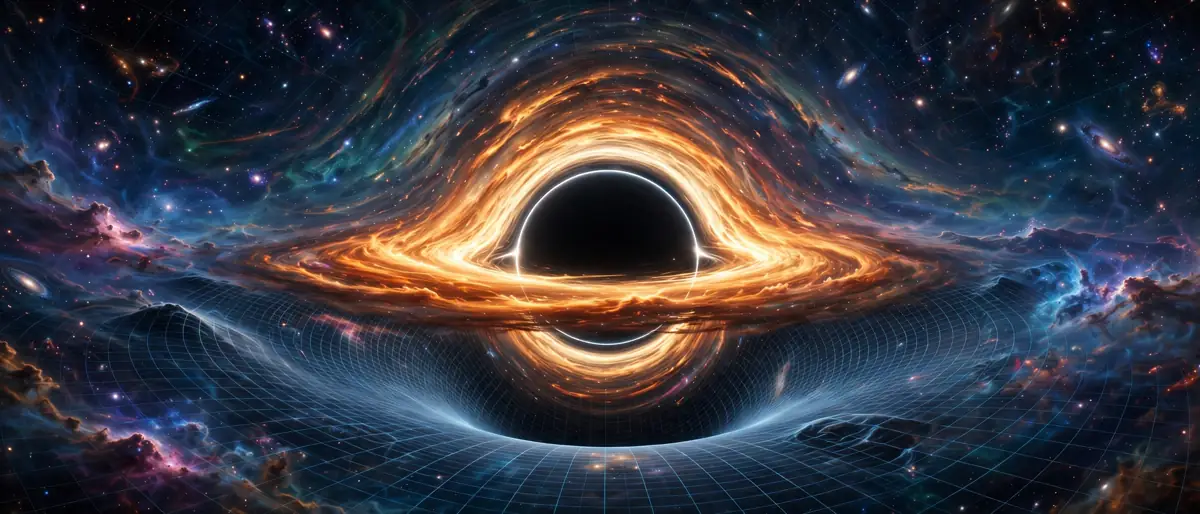
It is the one place in the universe we can describe with mathematics but never observe: the inside of a black hole. Everything astronomers know comes from the outside — from light bent around the edge, from stars orbiting something invisible, from the gravitational waves of collisions. What happens past the event horizon is where physics reaches the edge of its own map. This article separates what the evidence supports, what theory predicts, and what movies simply invented. It is the natural deep dive after our broader tour of space mysteries explained.
First, the Anatomy: What a Black Hole Actually Is
A black hole is not a hole and not really an object — it is a region of space where mass has been compressed so densely that gravity defeats everything, including light. Three landmarks matter:
- The event horizon: the boundary of no return. Cross it, and every possible path leads inward, because escaping would require moving faster than light.
- The accretion disk: superheated gas spiraling in outside the horizon — this glowing ring is what telescopes actually photograph.
- The singularity: in Einstein’s equations, the point at the center where density becomes infinite. Physicists widely regard “infinite” as a sign the theory is incomplete there, not a literal description of nature.
The black hole’s size depends on its mass. A stellar black hole, born from a collapsed massive star, might pack several suns’ worth of mass into a horizon only tens of kilometers across. Supermassive black holes at galaxy centers hold millions or billions of solar masses.
The Fall In: What Theory Says You Would Experience
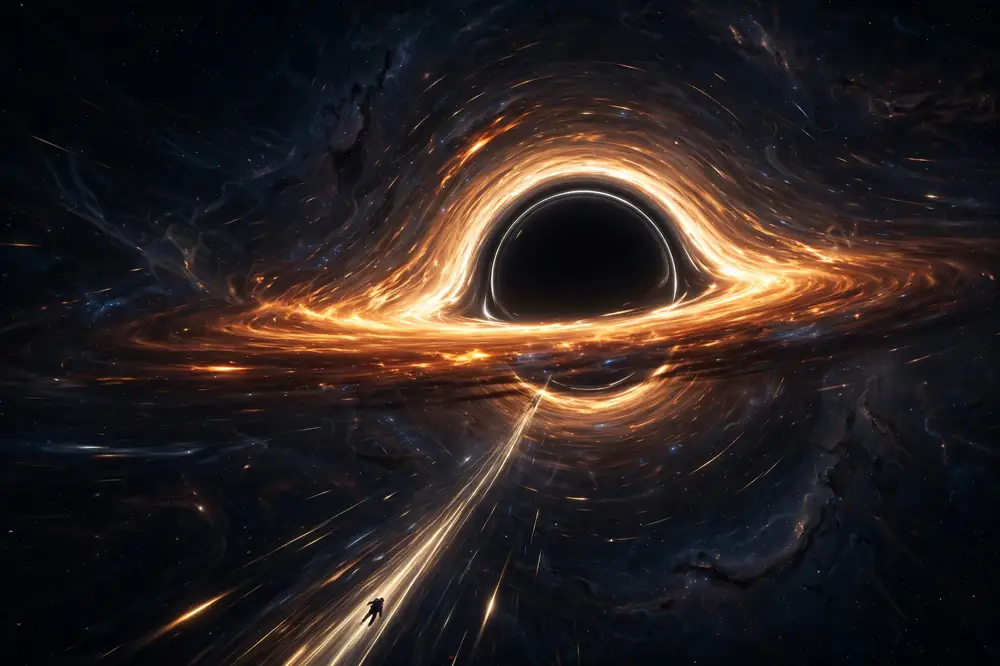
No one has fallen into a black hole, and no signal could report back. But general relativity makes testable-feeling predictions about the journey:
Approaching the horizon
For a large, supermassive black hole, crossing the event horizon might be unremarkable at the moment it happens — the gravity gradient there can be gentle. For a small stellar black hole, you would never reach the horizon intact.
Spaghettification
Gravity pulls harder on the parts of you nearest the hole than on the parts farther away. Fall feet-first and your feet are pulled much more strongly than your head, stretching you — and eventually every object — into a long stream of matter. This tidal stretching, nicknamed spaghettification, is a genuine prediction of the physics, not a screenwriter’s invention.
Time effects
To a distant watcher, your fall would appear to slow down and freeze at the horizon, your light stretched ever redder — an effect of how gravity warps time itself. From your own perspective, the crossing and the fall inward would take a finite, short time. Both descriptions are correct within relativity; they are different observers’ honest accounts of the same events.
The singularity
In the classical theory, all paths inside lead to the singularity, where the equations break down. What actually happens there is unknown — it is precisely the place where a quantum theory of gravity, which physics does not yet possess, is needed.
The Information Paradox: The Real Mystery
Here is the deepest open problem. Quantum mechanics says information about what fell in — what the matter was, how it was arranged — cannot be destroyed. Black holes, however, were shown by Stephen Hawking to slowly evaporate by emitting radiation, and that radiation did not appear to carry the information back out. If the hole evaporates completely and the information is gone, quantum mechanics is violated. If the information escapes, classic black hole physics needs revision.
Decades of theoretical work, including ideas about the horizon encoding information somewhat like a hologram, have shifted many physicists toward “the information comes out, in a scrambled form” — but this remains an active theoretical debate, not a settled experimental result. It is unresolved physics at the highest level, and any source claiming a final answer is overstating the case.
What the Evidence Actually Shows
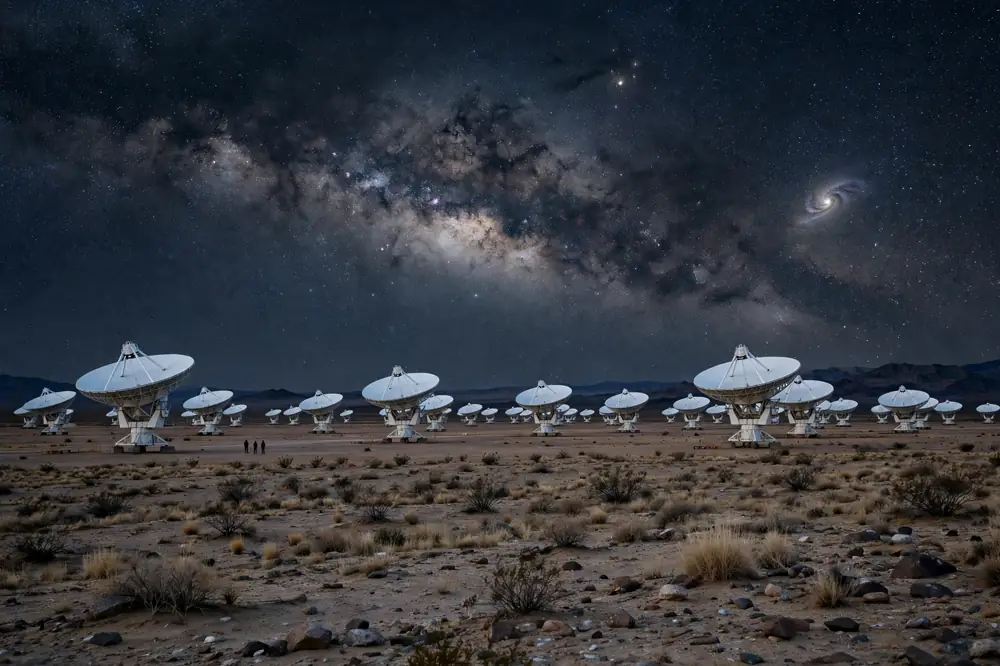
Everything verified about black holes comes from outside the horizon:
| Evidence | What it proves |
|---|---|
| Direct images of glowing rings | Matter orbiting a dark, compact mass whose size matches horizon predictions |
| Stars orbiting an invisible center | A mass of millions of suns confined in a tiny volume — only a black hole fits |
| Gravitational waves from mergers | Colliding compact objects whose signals match black hole merger predictions in detail |
| Jets and flares from galactic centers | Enormous energy released by matter falling toward (not into view of) the horizon |
Notice the pattern: the evidence is overwhelming that black holes exist and behave as relativity describes — from outside. The interior has no evidence at all, in principle, which is why claims about it must be labeled theory or speculation.
Common Myths, Corrected
- “Black holes suck things in like vacuum cleaners.” False. At a distance, a black hole’s gravity is ordinary for its mass. Replace the Sun with an equal-mass black hole and Earth’s orbit would not change — we would freeze in the dark, not get pulled in.
- “Black holes are holes to other universes.” Speculation. Some mathematical solutions contain structures that inspire the idea, but there is no evidence, and the realistic versions of these solutions are expected to be unstable. It belongs in the “unproven theory” drawer.
- “Anything that crosses the horizon is instantly crushed.” Not necessarily. For a supermassive black hole, crossing could initially feel like nothing special; destruction comes later, on the way in.
- “Hawking radiation means black holes are not really black.” They evaporate so slowly that for any real black hole the effect is negligible for now — a stellar black hole would take vastly longer than the current age of the universe to evaporate.
- “Time travel through black holes is established science.” It is not. Rotating black hole mathematics contains exotic features, but whether they can exist or be used in reality is speculation, widely doubted by physicists.
The universe’s other great unknowns — including where life might exist among the worlds these same telescopes study — are covered in our article on the search for life beyond Earth.
Frequently Asked Questions
Can anything ever come out of a black hole?
Nothing that crosses the event horizon can come back out — that is the definition of the horizon. The exception debated by physicists is Hawking radiation, emitted from just outside the horizon over immense timescales, which may carry information about what fell in. Nothing material returns.
What is inside a black hole, in one sentence?
According to our best current theory, matter crushed toward a central point where the known laws of physics stop working — which is science’s way of saying the honest answer is “we do not know yet.”
Could a black hole swallow Earth?
No known black hole is anywhere near us, and black holes do not roam around consuming things. Earth would have to be aimed almost directly at one to fall in; distant orbits around black holes are perfectly stable.
Will the Sun become a black hole?
No. The Sun is not massive enough. At the end of its life it will shed its outer layers and leave behind a white dwarf — a dense ember that slowly cools. Only stars far more massive than the Sun can collapse into black holes.
The Bottom Line
Inside a black hole is the one destination where our two best theories — relativity and quantum mechanics — contradict each other and neither can be checked by observation. That is exactly why it fascinates: the facts are solid, the myths are entertaining, and the center of the map honestly reads unknown.