

Everyone has had the same experience: a burst of motivation on Monday, a perfect plan, total conviction — and by Thursday, the plan is quietly abandoned. It is tempting to conclude you lack discipline. Psychology suggests something kinder and far more useful: motivation is a weather pattern, not a foundation, and the people who change successfully do it by designing their environment so the right behavior becomes the easy behavior. This guide explains how habits actually work and how to build your surroundings to work for you instead of against you.
A quick note before we start: This article is general information and education about everyday behavior change. It is not medical or psychological treatment. If you are dealing with addiction, compulsive behavior, or a mental health condition, a qualified professional can offer support designed for your situation — see our guide to Online Therapy and Mental Health Support.
Why Motivation Always Runs Out
Motivation is an emotion, and like all emotions it rises and falls with sleep, stress, hunger, mood, and the events of the day. A system that requires you to feel like it before acting will fail on precisely the days you need it most — the tired, busy, difficult days. Motivation is genuinely useful for one thing: getting started and making a plan. Keeping going belongs to a different mechanism entirely.
There is a second trap: motivation creates oversized plans. Inspired, we design the routine of our ideal self — an hour of exercise, a perfect diet, two hours of study. The plan is calibrated for our best day, so our average day breaks it, and each break feels like proof that we cannot change. The conclusion is wrong; the design was.
How Habits Actually Work: Cue, Action, Reward
Behavioral psychology describes habits as loops with three parts:
Cue — the trigger: a time, a place, a preceding action, an emotional state, or other people.
Action — the behavior itself, ideally small and specific.
Reward — something your brain registers as worthwhile right away: satisfaction, relief, a ticked box, a pleasant sensation.
Repeat the loop in a stable context and the behavior becomes increasingly automatic — initiated by the cue rather than by a daily act of will. This is why you brush your teeth without a motivational speech: the loop is old, cued by the bathroom and bedtime, and the action is effortless. Every durable habit in your life already works this way. New ones must be built the same way.

Environment Beats Willpower
The practical conclusion of habit research is almost disappointingly simple: you are more likely to do what your environment makes easy, visible, and immediate — and less likely to do what it makes hard, hidden, or delayed. Consider the evidence of everyday life:
- People eat more of the snacks sitting on the counter than the ones in a closed cupboard — same person, same hunger, different friction.
- A guitar on a stand gets played; a guitar in a case in a closet does not.
- Phones charge behavior all day because they are always within reach, always visible, always rewarding in seconds.
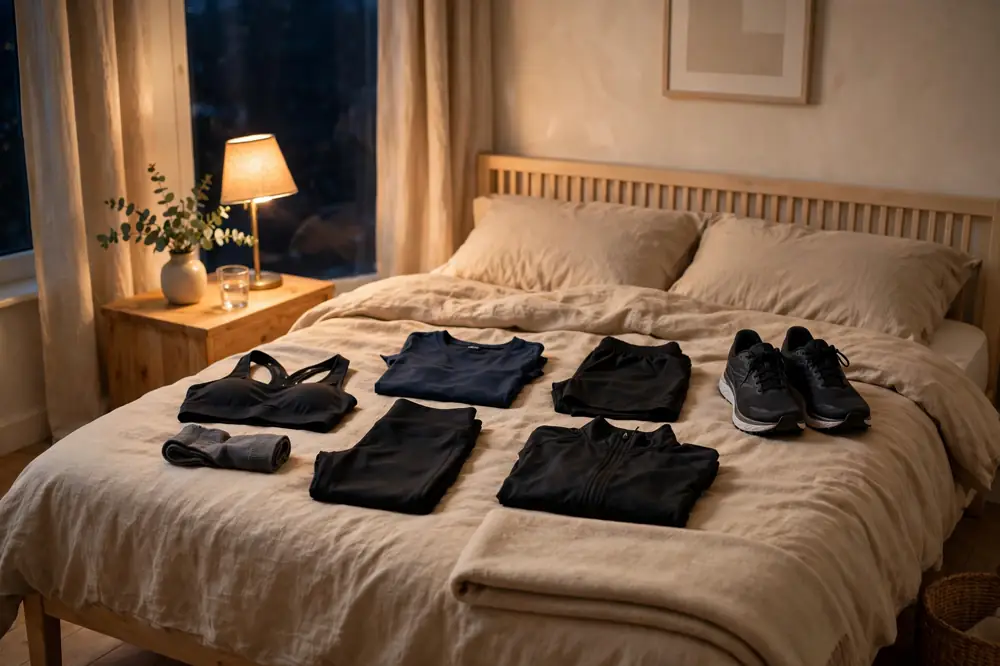
Willpower enters the story far less than design does. Laying out workout clothes and shoes the night before is not a trivial ritual — it removes three decision points and puts the cue in your path. That is environment doing the work motivation could not.
Designing Your Environment: The Four Levers
1. Make the cue obvious
Attach the new habit to something that already happens reliably — after coffee, after brushing your teeth, when you close your laptop. This “habit stacking” gives the new behavior a trigger that never forgets. Put the props in sight: book on the pillow, vitamins beside the kettle, walking shoes by the door.
2. Make the action tiny
Shrink the habit until it is almost embarrassingly small: two minutes of stretching, one page, a five-minute walk, a single set of squats. Tiny actions get done on bad days, and bad days are where habits are actually built. Small sessions also grow naturally once started — beginning is the hard part, and you have made beginning easy. This is exactly how the beginner routines in Home Workout Plans for Beginners are designed to be entered.
3. Make the reward immediate
Distant rewards (health in ten years, a goal weight by summer) are weak motivators for today’s brain. Add an immediate one: mark the calendar streak, enjoy the shower after the workout, savor the genuinely pleasant feeling and name it. Your brain repeats what it was rewarded for now.
4. Add friction to the habits you want less of
Raise the cost of unwanted behavior by even a little: phone charging outside the bedroom, streaming apps logged out, junk food bought in single servings rather than stored at home, social media moved off the home screen. Twenty seconds of extra friction, applied at the moment of temptation, defeats a surprising amount of impulse. The same principle protects your evenings in Stress, Sleep and Focus.
Planning for the Days It Goes Wrong
Missing once has almost no effect on a habit; missing repeatedly and concluding “I’ve blown it” is the real danger. Two tools help:
Never miss twice. Treat a single miss as weather and the next day as the recovery that matters.
Pre-decide your minimum. On the worst day, what is the smallest version of the habit you will still do? Decide in advance, when you are calm, so a hard day has a plan instead of a negotiation.
Identity helps too. Each completed rep is evidence for the story “I am someone who trains / writes / saves” — and people protect behaviors that match who they believe they are. You are not chasing a streak; you are collecting proof.
Frequently Asked Questions
How long does it take to form a new habit?
It varies widely with the behavior and the person — simple habits in stable contexts can feel automatic within a few weeks, while complex ones take months. There is no magic number of days; consistency in the same context matters more than the calendar.
Can I build several habits at once?
Usually, one or two at a time works far better. Each new habit competes for the same attention and routine space. Stack one until it runs on its own, then add the next.
How do I break a bad habit?
You rarely delete a loop; you redesign it. Identify the cue and the reward the behavior provides, then build an easier, competing action that delivers a similar reward — and add friction to the old path with environment changes.
What if my environment cannot change much?
Work with the levers you do control: anchor cues to existing routines, tiny versions of the action, visible props, and small friction changes like where your phone charges. Even one lever, applied consistently, shifts behavior noticeably over time.
The Bottom Line
Stop waiting to feel motivated. Pick one behavior, attach it to a cue that already happens, make it tiny, reward it immediately, and shape your surroundings so the right choice is the easy one. That is not a lesser version of willpower — it is how lasting change actually works.
1 thought on “The Psychology of Habits: Why Motivation Fails and How Environment Changes Behaviour”