
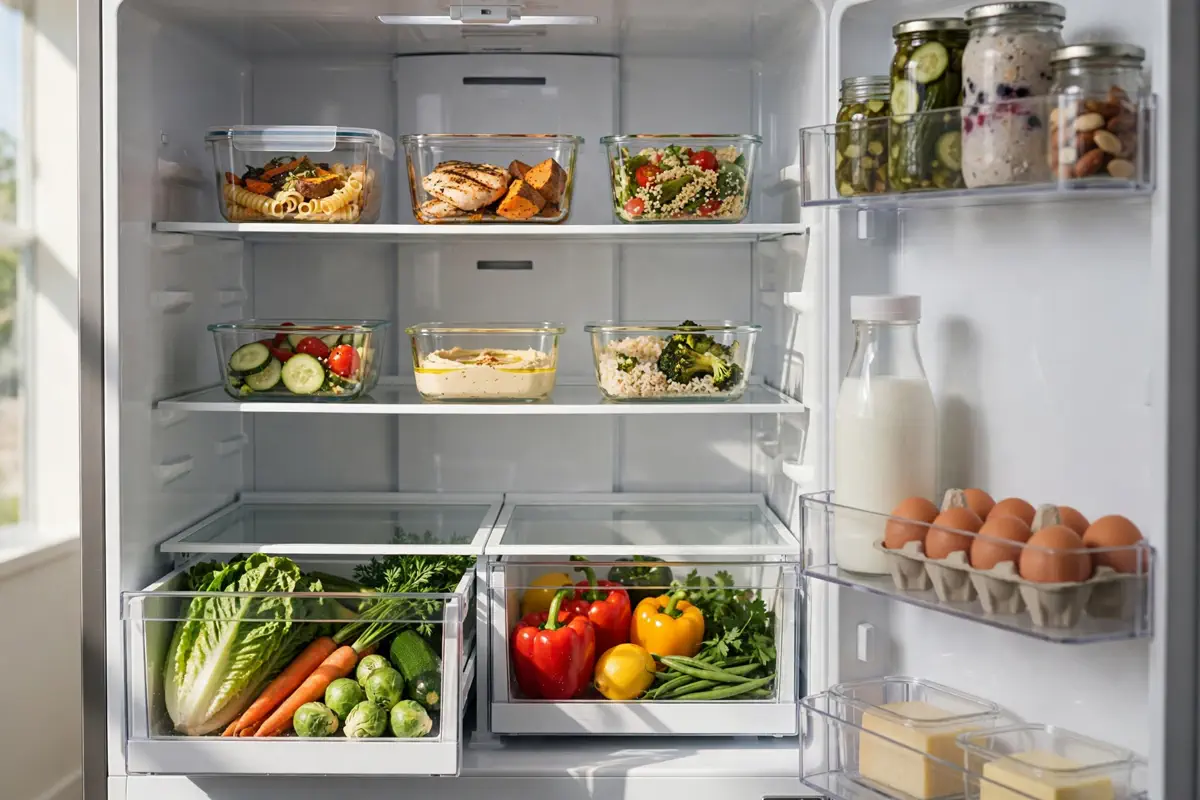
Most food poisoning and most food waste at home trace back to the same three causes: food stored at the wrong temperature, food kept past its safe life, and food forgotten in the wrong part of the fridge. This guide fixes all three with plain rules based on standard food-safety guidance. You will find the two temperatures that matter, a map of where food belongs inside your fridge, storage-time tables for the fridge and freezer, and the leftover rules that keep batch cooking — like the recipes elsewhere in this category — both safe and worth eating.
The Two Temperatures and the Danger Zone
- Fridge: 40°F (4°C) or below. Use an inexpensive fridge thermometer; the dial setting alone is not a guarantee.
- Freezer: 0°F (−18°C) or below. At this temperature food stays safe indefinitely in theory, but quality declines over the times listed below.
- The danger zone: 40–140°F (4–60°C). Bacteria multiply quickly in this range. Perishable food should not sit in it for more than 2 hours total (just 1 hour if the room is above 90°F / 32°C — think summer picnics and hot cars).
- Hot food stays hot: serve and hold cooked food at 140°F (60°C) or above, and reheat leftovers to 165°F (74°C) until steaming throughout.
One more cooling rule that surprises people: hot food can go straight into the fridge. Modern refrigerators handle it easily. The old advice to cool food completely on the counter first actually keeps it in the danger zone longer. Divide large pots into shallow containers (about 2 inches / 5 cm deep) so they chill fast and evenly.
Fridge Zones: Where Everything Belongs
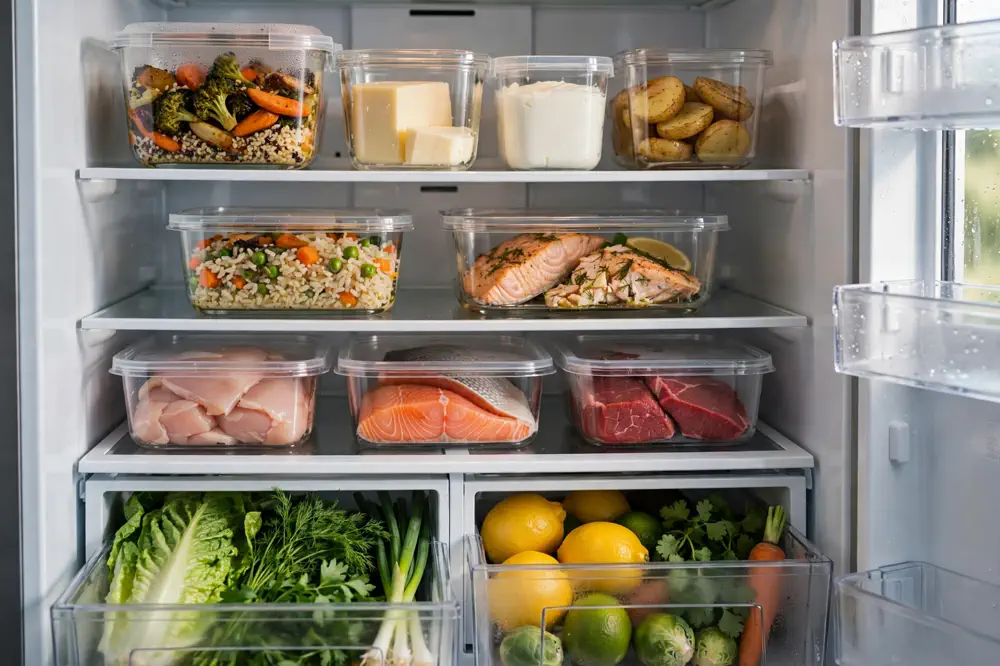
Your fridge is not one temperature. The door is the warmest spot; the back of the lower shelves is the coldest and most stable.
- Door: condiments, jams, pickles, and drinks only. It is too warm and too variable for milk and eggs, despite the built-in egg tray suggesting otherwise.
- Upper shelves (most consistent temperature): ready-to-eat foods — leftovers, deli items, yogurt, cheese, and drinks.
- Lower shelves (coldest): raw meat, poultry, and seafood, always on a plate or in a container to catch drips, and always below ready-to-eat food so nothing can drip onto food that will not be cooked again.
- Crisper drawers: vegetables in the higher-humidity drawer, fruit in the lower-humidity one. Keep ethylene-producing fruit (apples, bananas, avocados) away from leafy greens, which yellow quickly beside them.
- Back of the fridge: milk and eggs live happily here, where the temperature is coldest and steadiest.
Fridge Storage Times (At 40°F / 4°C or Below)
| Food | Fridge life |
|---|---|
| Ground meat and ground poultry | 1–2 days |
| Steaks, roasts, and chops (raw) | 3–5 days |
| Raw chicken pieces | 1–2 days |
| Fresh fish and seafood | 1–2 days |
| Cooked meat, poultry, and leftovers | 3–4 days |
| Cooked rice and pasta dishes | 3–4 days |
| Soups and stews | 3–4 days |
| Eggs in the shell | 3–5 weeks |
| Hard-boiled eggs | 1 week |
| Opened milk | About 5–7 days (follow the date and the smell test) |
| Hard cheese, opened | 3–4 weeks |
| Soft cheese, opened | 1–2 weeks |
| Deli meats, opened | 3–5 days |
| Fresh berries | 2–3 days (wash just before eating) |
| Leafy greens | 3–5 days, dry and wrapped |
These are the standard conservative guidelines for home refrigerators. Package dates (“use by”) always win when they are shorter.
Freezing Times (For Best Quality at 0°F / −18°C)
- Ground meat: 3–4 months · Steaks and roasts: 6–12 months · Chicken pieces: up to 9 months; whole chicken up to 12 months
- Cooked meat dishes, soups, and stews: 2–3 months
- Cooked rice and grains: up to 6 months
- Fish: lean fish 6–8 months; fatty fish (salmon, mackerel) 2–3 months
- Bread and baked goods: 2–3 months · Butter: 6–9 months · Milk: 3–6 months (texture changes; best for cooking)
- Vegetables (blanched first): 10–12 months · Fruit: 8–12 months
Freeze well, not just cold: wrap tightly to exclude air (air is what causes freezer burn), label with contents and date, freeze in serving-size portions, and lay bags flat so they stack and thaw quickly. Freezer burn is a quality problem, not a safety one — trim the dried-out patches and use the food in soups or sauces where texture matters less.
Thawing safely, three ways: (1) in the fridge overnight (the default; allow about 24 hours per 4–5 lb of meat); (2) in cold water, changing the water every 30 minutes, for same-day cooking; (3) in the microwave, only if the food will be cooked immediately. Never thaw perishable food on the counter.
The Leftover Rules
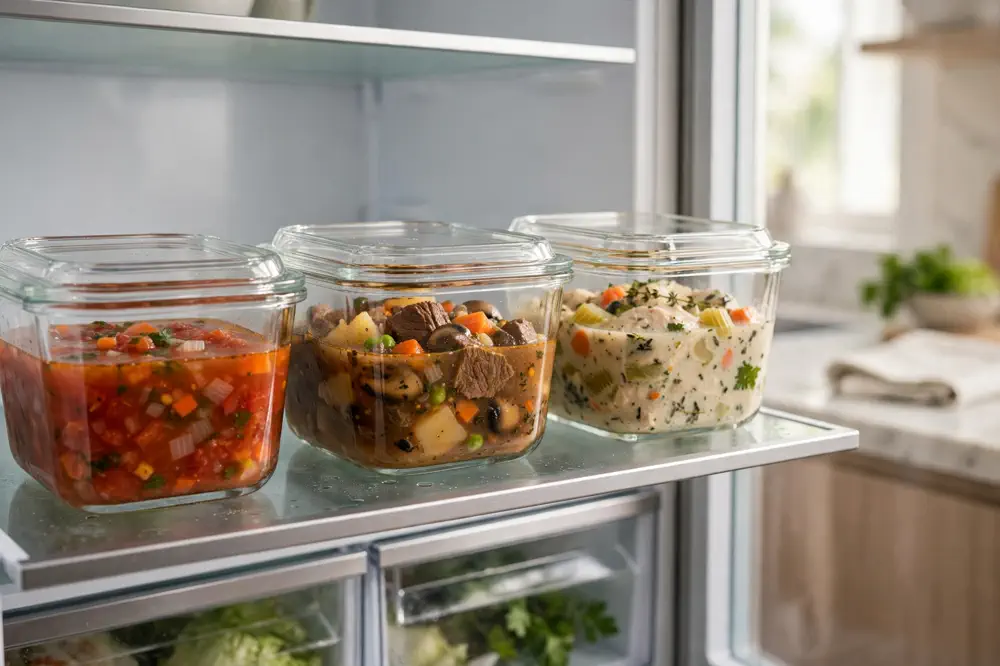
- Two hours, then fridge. Set a phone timer when a meal ends if your household tends to linger.
- Shallow containers, sealed, labeled with the date. If you cannot remember when you cooked it, it has been too long.
- Three to four days, then the freezer or the bin. When you batch cook for the week, as in the meal prep system for beginners, freeze the portions meant for day five onward on prep day itself.
- Reheat once, to steaming hot (165°F / 74°C). Take out only the portion you will eat; reheating the whole pot repeatedly degrades both quality and safety.
- Rice needs extra care. Cooked rice should be cooled quickly (within an hour), refrigerated, eaten within 24 hours ideally (up to 3–4 days at most), and reheated until piping hot — uncooked rice can carry spores that survive cooking and grow if rice sits warm.
- When in doubt, throw it out. The sniff test misses plenty of harmful bacteria, which often produce no smell at all. No single serving is worth a day of food poisoning.
Putting It to Work With This Category’s Recipes
The big-batch dishes are the ones that benefit most: the chili and stew from slow cooker and one-pot dinners freeze exactly as described above; the protein bowls from high-protein meal prep follow the 3–4 day rule; and the fridge-organization habit of “first in, first out” is the storage half of the grocery budget guide — food you can see is food you use before it spoils.
Frequently Asked Questions
Is it safe to put hot soup straight into the fridge?
Yes — in fact it is safer than leaving it out to cool. Divide the soup into shallow containers first so the center chills quickly, leave lids slightly vented until cold, then seal.
Can I refreeze meat that has thawed?
If it was thawed in the fridge and is still within its storage time, refreezing is safe but quality suffers. Food thawed in cold water or the microwave should be cooked first; after cooking, it can be frozen again.
The date on the package passed yesterday. Must I throw the food out?
“Best by” and “sell by” dates are quality guides, not safety deadlines, for most foods. “Use by” dates deserve more respect. Combine the date with storage history and condition — but remember the rule above: genuine doubt means the bin, not the plate.
How do I stop fresh herbs and greens from dying in the crisper?
Treat soft herbs like flowers: stems in a jar of water, loosely covered, in the fridge. Wrap greens in a dry paper towel inside their container to absorb moisture. Both tricks routinely double usable life.
The Takeaway
Cold enough, short enough, and in the right zone: almost every storage rule is a version of those three. Set the fridge to 40°F, label and date what goes in, and let the freezer — not optimism — extend your food’s life.
2 thoughts on “Kitchen Storage and Food Safety: Fridge Zones, Freezing Times and Leftover Rules”