
This is an original work of fiction written for Discover. The village, the fair and every person in it are invented — but the trick follows the fair-play rules of the classic English mystery: every clue you need is on the page.
The Fair at Little Wenford
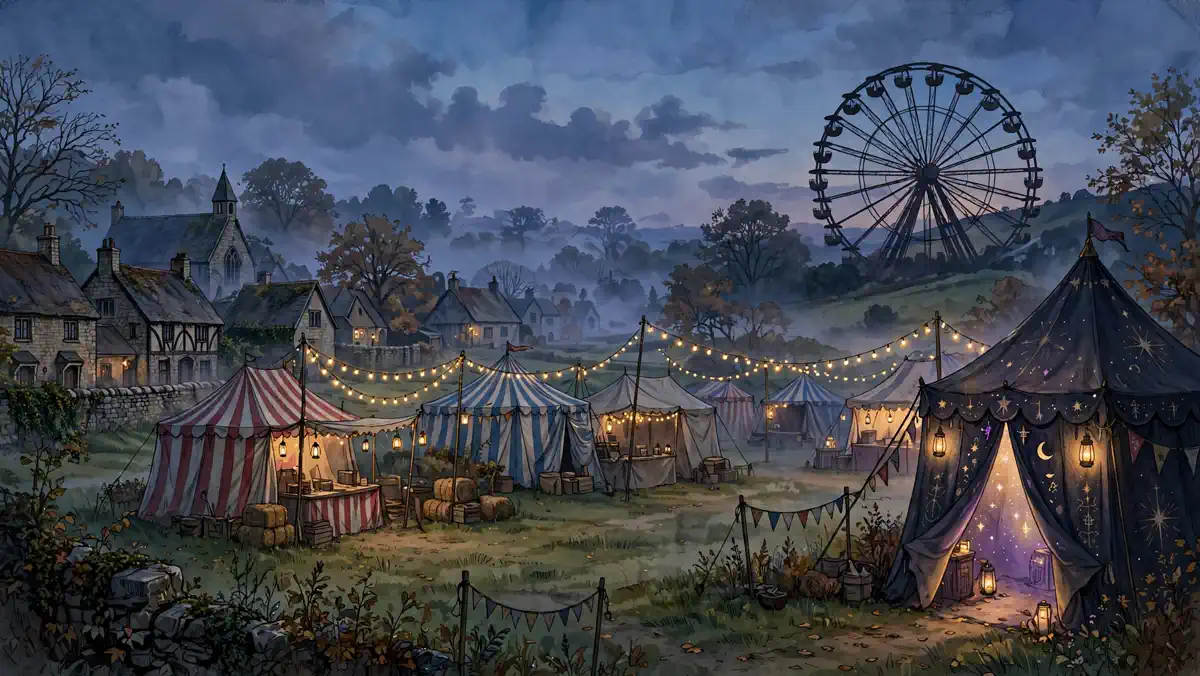
The Little Wenford fair came every September: coconut shies and a coconut that had never once been won, a tombola, a brass band that played slightly too fast, and — in the striped tent at the far end of the green — Madame Rosa, who told fortunes.
Madame Rosa was not called Rosa, and she was not from anywhere more exotic than Leeds. Her name was Elsie Barlow. She was sixty-one, sharp as a tack, and she had read palms at the Wenford fair for twenty-two years. She had a rule she announced to every customer: “I tell you what you need, which is not always what you came for.”
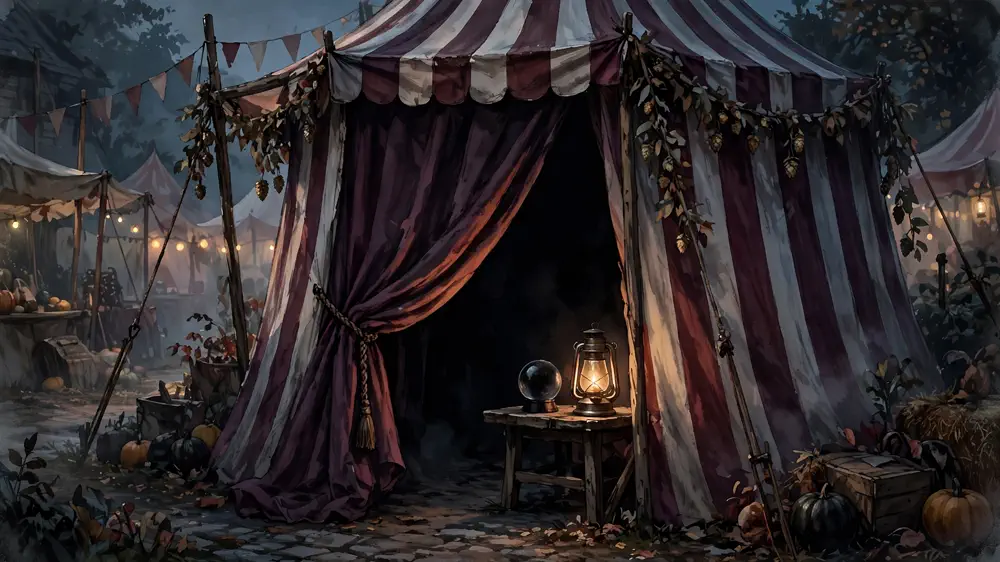
On the Saturday in question, at twenty past four, Elsie Barlow entered her tent in front of at least a dozen witnesses, drew the flap closed — and when her four-thirty customer finally pushed inside at twenty-five to five, having waited and knocked and waited again, the tent was empty. The chair was there, and the little table with the crystal ball, and a cup of tea standing cooling beside them. But Elsie Barlow was gone, and the tent, as half the village would testify by nightfall, had only one way in or out.
A Tent With One Door
Or so everyone said. Tents, as PC Alan Reyes pointed out when he arrived, are mostly door. “You could go under the canvas anywhere.”
But old Mr. Fenner, who had put the tent up that morning, shook his head. “Pegged it myself. Every loop. And the ground’s hard as iron — no rain in three weeks. You’d see the marks.”
There were no marks. The grass inside was undisturbed, the tea still faintly steaming, and Elsie’s handbag — the day’s takings in a biscuit tin — sat under the table where it always sat. She had taken neither her money nor her coat. She had vanished from a tent watched, on and off, by dozens of people — and watched continuously by one person nobody thought to ask until much later: Toby Marsh, aged nine, who had spent the afternoon in the long grass behind the tea stall with a jam sandwich, keeping out of everyone’s way.
What the Witnesses Saw
The other witnesses were all telling the truth, just not the whole of it.
Mrs. Ada Cole, who ran the tea stall, saw Elsie enter the tent at twenty past four. She was sure of the time because the band had just started her tune, the one they played at half past — though, when pressed, she admitted the band had been running late all day.
Young Harry Fenner, who had pegged the tent, saw a woman in a red scarf leave it at about ten to five and walk toward the car park. He did not see her face. He did not think to mention that the woman was taller than Elsie, because nobody asked him how tall she was.
Mrs. Pritchard, the four-thirty customer, knocked, received no answer, and finally went in. She described the empty tent, the warm tea, and the crystal ball — which she described as cloudy.
And the Reverend Mr. Hale saw Elsie Barlow, unmistakably, at ten past five — at the far end of the car park in her ordinary coat, talking to a man he didn’t know, beside a blue car he didn’t recognize.
A short woman vanished from a tent at twenty past four. A tall woman in her shawl left it at ten to five. And Elsie herself was seen, alive and ordinary, at ten past five. If you enjoy untangling testimony like this, try our logic puzzles with answers — every fact is true, and the picture is still wrong.
The Boy in the Long Grass
Toby was found when his mother came looking for him at six o’clock, emerging with grass in his hair and the air of a boy who has been waiting to be asked the right question. He had seen a lady come out of the back of the tent. Not under the canvas — through it: the back of the tent had a flap, a zipped repair panel, knee-high, dark green against the stripes, invisible unless you were lying in the grass at exactly Toby’s height, at exactly Toby’s angle.
“A lady unzipped it and crawled out,” said Toby. “She had a red scarf. Then she zipped it up from outside, with a string. Then a man came and they put stuff under his coat. Books, I think. Then he limped. Then they went to the cars.”
Nobody, until that moment, had asked Toby anything at all.

What Actually Happened
The tall woman in the red shawl was Diane Barlow, Elsie’s niece, a nurse from the county town, six inches taller than her aunt and the owner of the blue car. The “man” was her husband, Colin, who played the limping stranger with the aid of two paperback novels and a rolled bandage, because Diane had told him — correctly — that a limp makes people remember a man and forget his face.
Elsie Barlow had not been kidnapped. She had retired — at twenty past four on fair day, in the middle of her own tent — because her late sister’s will had left the fortune-telling pitch and the name “Madame Rosa” jointly to Elsie and to a cousin in Australia, and the fair committee, scenting a dispute, had voted that morning to ban Elsie from the pitch until the matter was settled. Too cowardly to tell her, they let her find out from the tombola lady, who could keep nothing.
So Elsie did the one thing that would make the ban unenforceable: she became impossible. A woman cannot be quietly removed from a pitch she has famously, publicly, impossibly vanished from. By Sunday the story was in the county paper. By the following September the committee had settled, the cousin had been bought out with money the village raised in a fortnight, and Madame Rosa returned to her tent.
She had left by the repair flap at half past four, while Diane — wearing her shawl — left grandly by the front ten minutes later, and Elsie herself walked calmly across the car park in full view of the vicar.
The crystal ball, Mrs. Pritchard said, had been cloudy. It was cloudy because Elsie had kept her kettle on it, to keep her tea warm. Some details are not clues. Some details are just tea.
The Moral of the Fair
Ask any of the witnesses, even now, and they will tell you the tent had one door, the woman wore the red shawl, and the fortune-teller vanished. All true. All useless. The mystery was never about a tent; it was about how a hundred people can watch the same afternoon and each come home with a different one — the same human trick that powers the locked-room mystery and half the classic English tales ever told. What the village needed, that September, was a reason to keep her. Elsie made sure they found one.
Frequently Asked Questions
Is this a true story?
No. It is an original work of fiction written for Discover; Little Wenford, Elsie Barlow and the fair are invented. The method, however — a hidden exit, a decoy in a distinctive scarf, witnesses who each saw a fragment — follows the fair-play rules of classic mystery writing.
What is a red herring in this story?
The limping stranger. Colin’s limp was deliberately memorable and completely unimportant: it made witnesses remember a suspicious man and forget to describe the woman beside him. Learn more in our guide to the locked-room mystery.
Why did nobody see Elsie leave?
Because everyone was watching the front of the tent, and Diane, in the famous red shawl, gave them something much more watchable to look at. Misdirection works by offering the eye a better story than the truth.
Did the story play fair with the reader?
Yes — the repair flap, the height difference, the late-running band and the cloudy crystal ball are all on the page before the solution. That is the classic rule: the reader must be able, in principle, to solve it first.