

Every good tale promises a surprise, but the finest English tales do something ruder: they make the beginning a lie you told yourself. A rescue that was really a theft. A haunting that was really a confession. A fortune that arrived one day too late to matter. The opening pages set one story in motion, and the final pages reveal you were reading another one all along.
Below are some of the most retold tale-types from English storytelling tradition — drawn from folklore, famous literary plots, and stories passed around for generations. Where a tale is legend rather than documented fact, we say so. That mixture is part of the tradition: England’s favorite stories have always lived halfway between the parish record and the fireside.
The Rescue That Was a Robbery: The Wreckers of the Coast
On stormy nights along the rocky coasts of Cornwall and Devon, so the legend goes, villagers would hang lanterns on cliffs and headlands to imitate the lights of a safe harbor. Ships, mistaking the glow for guidance, would strike the rocks — and the wreckers would be waiting on the shore for the cargo.
The beginning of the tale is a shipwreck, a tragedy of weather. The ending is far stranger: the tragedy was a business. Historians still debate how widespread deliberate wrecking really was; there is solid evidence of communities looting wrecks, and much thinner evidence for false lights. The legend endured because it contains an uncomfortable truth about poverty and opportunity on a dangerous coast, where a wreck could feed a village for a winter. Fact and folklore are tangled here, and honest retellings keep them labeled as such.
The Photograph That Gave Away the Secret
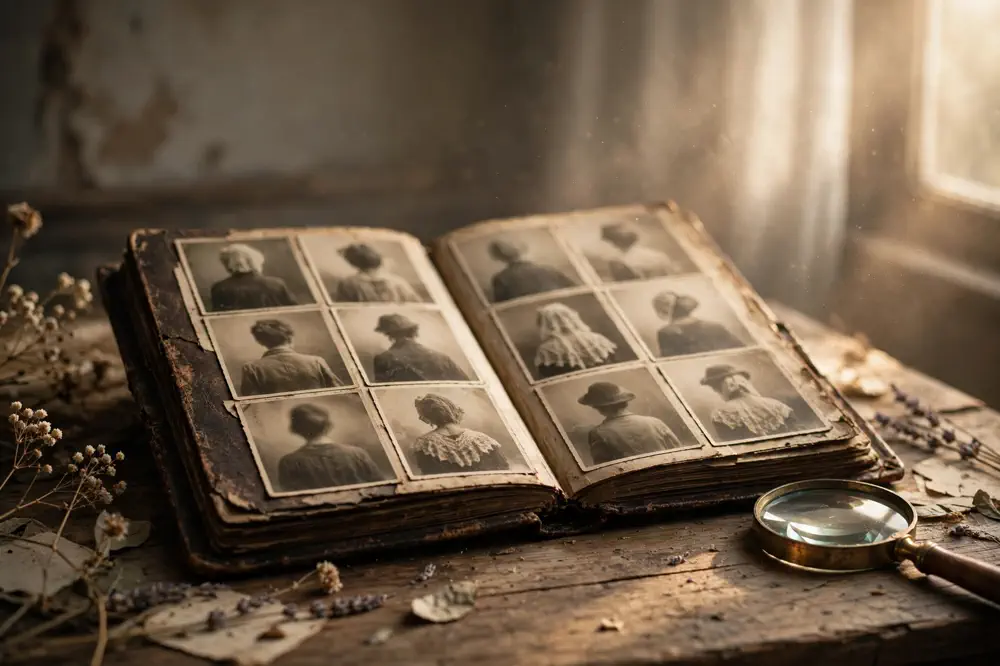
A recurring tale in English family lore: after a death, relatives sort through a house and find a photograph — a wedding group, a seaside holiday — with one face too many, or one face that should not be there. In the most famous versions, the stranger in the photograph is a sibling no one mentioned, a first spouse erased from the family story, or the true parent of the child standing in front.
These stories are rarely provable and often grow with each telling. Yet they persist because they are built on something real: families in the past genuinely did keep such secrets, and the arrival of a photograph in an attic or a tin box genuinely has detonated more than one carefully maintained version of events. Our own original story for this site, The Lost Letter, uses the same device: a single hidden object that rewrites forty years of family history.
The Message That Arrived Decades Late
England’s storytelling tradition loves a delayed letter, and the pattern appears in tale after tale: a soldier’s last letter delivered to the wrong street and opened by grandchildren; a confession posted in anger, hidden by a kind postman, and found behind a drawer fifty years on; a proposal of marriage that reaches its reader when both sender and receiver are in their eighties.
The strange ending is not the delivery. It is what the message does when it lands in the wrong decade. Apologies arrive after forgiveness is impossible. Invitations arrive after the house is sold. The tale begins as a story about the post and ends as a story about time, which is why these narratives are retold whenever a real delayed letter makes the news — as happens surprisingly often.
The Haunting That Was a Confession
The classic English ghost story often turns on a misunderstanding: a figure seen at a window, footsteps in an empty corridor, a name spoken in a house where no one should know it. In the tales with the strangest endings, the “ghost” is a living person carrying a secret — a hidden child visiting a grave, an old servant returning to a house they were banished from, a sweetheart believed dead who had simply never been told the war was over.
The supernatural opening gets the audience. The human ending keeps them. This is the engine of the traditional English tale at its best, and it is also the trick behind the locked-room mystery: a sealed, impossible situation that opens, at the end, onto an ordinary and rather sad human reason.
The Fortune That Came Too Late
A poor relative is left a fortune by an eccentric stranger. A worthless painting is found to be a masterpiece. A miner’s ugly stone is a diamond. English tales love the sudden fortune — and love even more the version where the fortune arrives uselessly late, or turns out to carry a condition that ruins it: the money can only be claimed by a man who never married, the estate must be spent in a year, the painting belongs to the nation.
These endings survive because they are not really about money. They are about the gap between what people wish for and what they actually need, and the best versions end not with the fortune but with the character quietly deciding they were happier before it. The tale that begins as luck ends as philosophy.
The Stranger Who Knew Too Much
A traveler arrives in a village knowing everyone’s names. A new curate finishes the rector’s sentences. A beggar at the fair predicts a drowning. The stranger-who-knows is one of the oldest figures in English storytelling, and the endings split into two families: the stranger is supernatural — a ghost, a saint, a devil come to collect — or the stranger is devastatingly ordinary: a childhood friend unrecognized, a dismissed servant, the child sent away decades ago, grown up and come home.
The ordinary version is usually the stranger one. It asks the question the whole tradition circles back to: how well do we ever know the people we grew up beside? It is the same question at the heart of The Vanishing at the Village Fair, our original tale of a disappearance in front of a hundred witnesses who all, somehow, saw different things.
Why These Endings Endure
Three ingredients repeat across the tales above:
- A reversal of identity. Someone is not who the opening said they were.
- A reversal of value. The worthless thing is priceless; the fortune is a burden; the rescue is a crime.
- A delay. The truth exists from the first page but travels slowly — by post, by photograph, by memory — and arrives changed.
English storytellers mastered the delayed truth because England itself was full of it: letters that took weeks, records kept in parish chests, families scattered by work and war and emigration. The strange ending was not a trick pasted onto the story. It was how life actually arrived.
Frequently Asked Questions
Are these tales true stories?
They are a mixture, and honest retellings label them. Some rest on documented events, some are literary plots, and many are folklore — stories shaped by generations of retelling. Where the evidence is thin, as with the wreckers’ lanterns, we flag the tale as legend rather than fact.
Why do English tales so often end with a hidden identity?
Because the hidden identity was a genuine feature of the world that produced them: servants, foundlings, second families, soldiers reported dead, children sent away. The twist ending grew out of real social conditions, which is why it still feels true.
What is the oldest kind of English tale?
Oral folk tales about strangers, bargains, ghosts and delayed messages predate printed fiction by centuries. Many were only written down in the 1800s, by collectors who found them still being told by firesides.
Where can I read an original tale in this style?
Try The Lost Letter, written for this site: a family secret hidden for forty years, told in the classic pattern — an ordinary beginning, and an ending that changes what the beginning meant.
A tale’s beginning is a promise, and the best English tales keep a stranger promise than the one you thought you heard. That is why we are still telling them.