
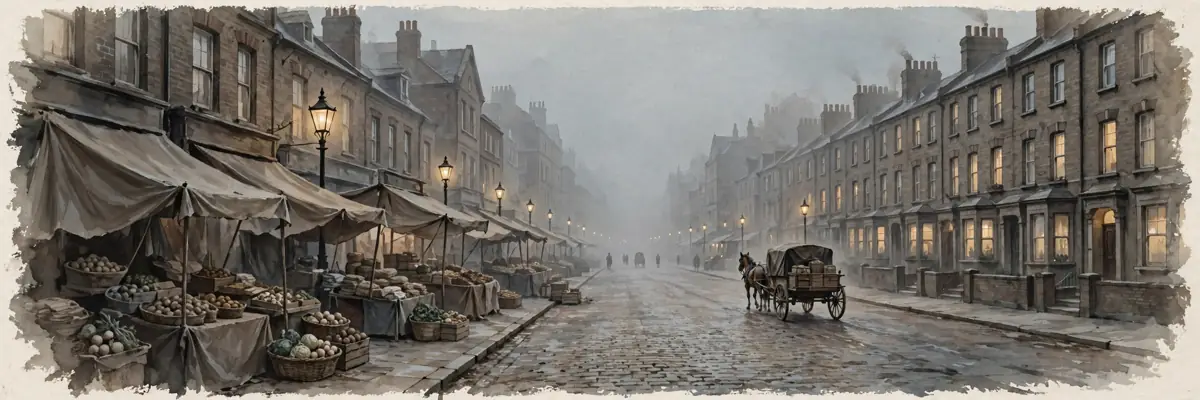
Queen Victoria reigned from 1837 to 1901, and in those 64 years Britain changed from a mostly rural country into the world’s leading industrial power. The history books remember the railways, the empire and the Crystal Palace. Everyday life, for most people, was something else: long factory shifts, bread-and-tea dinners, whole families in two rooms, and water that could kill you. This article opens the front door on ordinary Victorian life — work, food, housing and health — and shows how the struggles of the poorest Victorians produced many of the protections we now take for granted.
Work: Long Hours for Adults and Children
The factory whistle ruled industrial towns. A typical mill hand in the early Victorian years worked 12 to 14 hours a day, six days a week, for wages that barely covered rent and food. Children worked too — in textile mills, in coal mines hauling tubs underground, and as chimney sweeps’ climbing boys. Reform came in stages. The Mines Act of 1842 banned the underground employment of women and of boys under ten. Factory Acts gradually limited children’s hours and, later, required part-time schooling for child workers. By the end of the era, the ten-hour day for textile workers had become law and elementary education was compulsory and free — changes won through decades of campaigning, not granted all at once.
Outside the mills, millions worked as domestic servants — the single largest category of female employment — or as costermongers, dockers, seamstresses and cab drivers. Sunday was the only rest day for most, and a week of paid holiday was a rarity until the very end of the period.
Food: Bread, Tea and the Weekly Roast
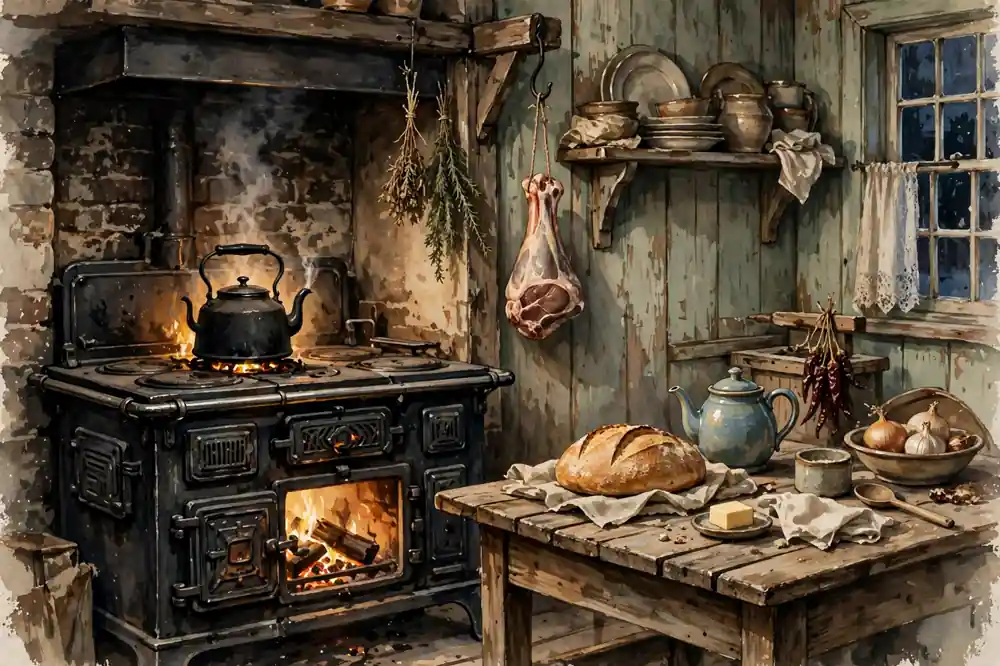
For a working-class family, the diet was built on bread, potatoes, cheese, tea and, when wages allowed, bacon or a small cut of meat for Sunday. Fresh milk and vegetables were hard to keep in unrefrigerated homes, so people shopped daily in small amounts. Food adulteration was a serious problem: alum in bread, watered milk and worse were common enough that Parliament passed a series of Food and Drugs Acts to crack down. Middle-class tables were richer — several courses, jellies and puddings — and Isabella Beeton’s Book of Household Management (1861) became the era’s famous guide to running such a home. Across all classes, tea became the national drink, cheap enough by mid-century to sweeten even the poorest kitchen.
Housing: Back-to-Backs, Cellars and the Privy
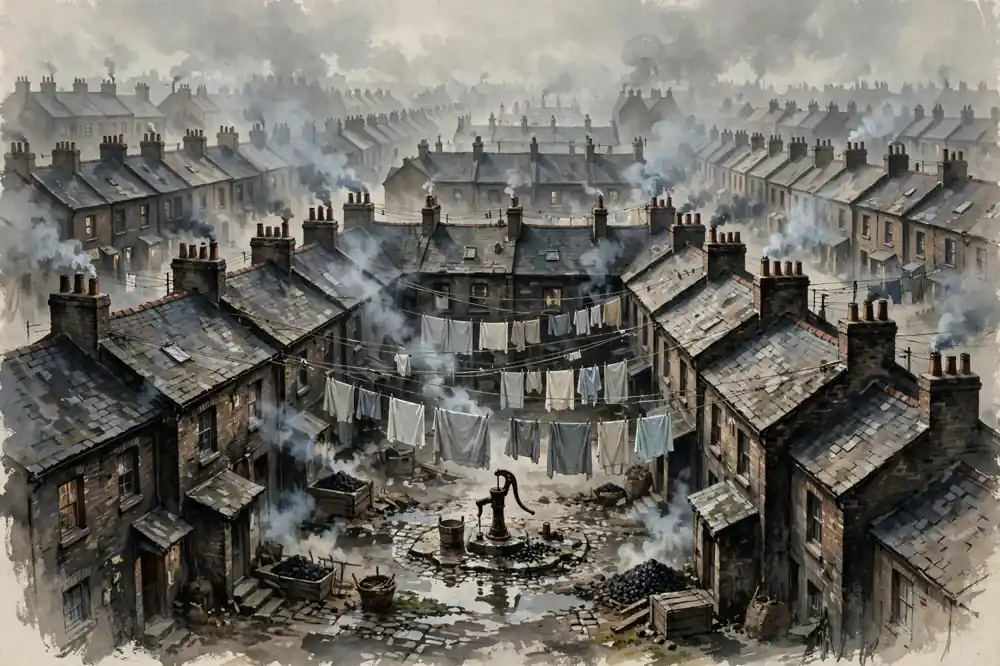
Industrial towns grew faster than anyone planned for. Workers crowded into hastily built back-to-back houses — terraces sharing walls on three sides, with no through ventilation — or into single rented rooms and even cellar dwellings. Many families shared one outdoor privy with dozens of neighbors, drew water from a communal pump, and emptied waste into open cesspools. For the destitute, the alternative was the workhouse, deliberately made harsh by the Poor Law of 1834 so that only the truly desperate would enter. Housing reformers documented these conditions street by street, and later Victorian councils slowly began clearing slums and building healthier streets with sewers and piped water. If conditions like these make you curious about daily life across the Atlantic, compare life in early America.
Health: Cholera, Smoke and the Sanitary Revolution
Victorian cities were deadly. Life expectancy at birth in Britain hovered in the low 40s nationally and was far lower in the worst industrial districts. Cholera, typhoid and tuberculosis did much of the damage, spread by contaminated water, bad drainage and crowded rooms. A turning point came in 1854, when Dr. John Snow traced a London cholera outbreak to the Broad Street water pump and had the pump handle removed — one of the founding stories of epidemiology, though the idea that germs, not “bad air,” caused disease took years to win acceptance. London’s Great Stink of 1858, when the smell of the Thames overwhelmed Parliament, pushed the government to fund Joseph Bazalgette’s vast new sewer system. Public Health Acts in 1848 and 1875 forced towns to take responsibility for water, drainage and waste. By 1901, the sanitary city was becoming real — and Victorian Britain’s population had roughly doubled despite it all.
Schooling and Childhood
For much of the era, childhood was short. Many working-class children left school — if they attended at all — by the age of ten or eleven to earn wages, and “half-timers” split their days between mill and classroom. Reformers pushed back steadily: the Education Act of 1870 created board schools to fill the gaps left by church schools, attendance became compulsory in 1880, and in 1891 elementary schooling became effectively free. Literacy climbed dramatically across the period, and by 1900 most young adults could read a newspaper and write a letter — a quiet revolution that changed what ordinary people could demand from politics, work and leisure. Childhood itself was also being reinvented in print: writers such as Charles Dickens, whose own boyhood included work in a blacking factory, forced readers to look at what industrial Britain did to its children.
Small Pleasures
Daily life was not only hardship. Cheap rail excursions took families to the seaside; music hall, football and fish and chips all became fixtures of working-class culture; and the new department stores and Christmas traditions — trees, cards, crackers — gave even modest households rituals to enjoy. The era that invented the factory shift also invented much of modern leisure. To place Victorian life among the great turning points around it, see American and British history’s turning points.
Frequently Asked Questions
How many hours did Victorian factory workers work?
Early in the period, 12 to 14 hours a day, six days a week, was common in mills. Laws passed across the century gradually shortened the working day, especially for women and young people, and by 1901 hours had fallen significantly in regulated industries.
What did poor Victorians eat?
Mostly bread, potatoes, cheese, tea and small amounts of bacon or meat, with herrings and cheap seasonal foods. Diets were monotonous and often short on protein and fresh vegetables, especially in winter and during unemployment.
Why was disease so common in Victorian cities?
Because waste, drinking water and housing were dangerously mixed: cesspools drained toward wells, rivers carried sewage past water intakes, and families crowded into damp, poorly ventilated rooms. Sewers, clean water and public health laws — the sanitary revolution — changed this step by step.
The Short Version
Victorian everyday life was a paradox: the richest empire on earth, built partly on 14-hour days, bread-and-tea dinners and streets without sewers. The reforms the Victorians were forced to invent — factory laws, clean water, public health, compulsory schooling — are the quiet architecture of modern life.
1 thought on “Everyday Life in Victorian Britain: Work, Food, Housing and Health”